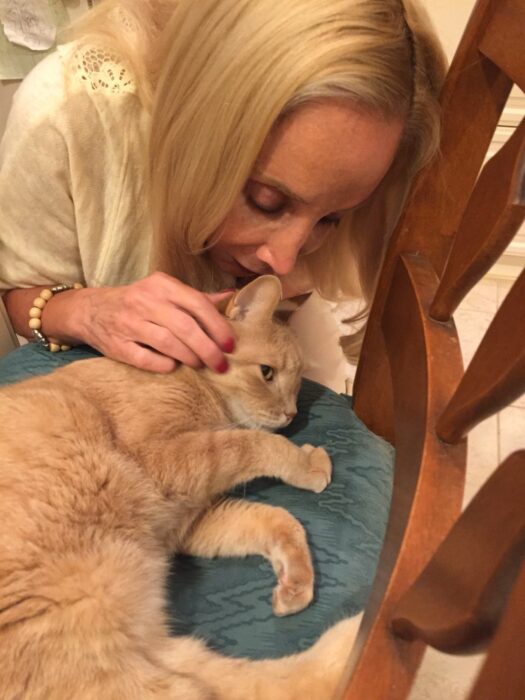
When Feebee passed away in April 2000, I was completely lost. He had been by my side for almost 16 years. He got me through my divorce and my mother’s death and quite literally saved my life during those dark days. After he died, all I felt was pain. It felt worse than the grief I experienced after my mother died a few years earlier. And then, after what seemed like endless days and weeks of trying to find something, anything, that would make the pain go away, I met Kathy Reiter.
Kathy is a licensed clinical social worker who specializes in pet loss counseling. At the time, she led pet support groups at three area shelters. After attending my first meeting, I started to feel hope. I started to feel that maybe I could survive this loss.

A bargain with the universe
50 years ago, Kathy was instrumental in starting the (human) hospice movement in the United States. As part of that work, she facilitated support groups for grieving family members. “People started coming up to me after the group meetings and confessing that they actually were there because their companion animal had died and they didn’t know how to cope,” said Kathy. “I realized that someone needed to start a support group especially for loss of pets.”
Right around that time, Kathy received an FIP (Feline Infectious Peritonitis) diagnosis for then 10-year-old cat Prince. FIP was a death sentence at the time. At most, her vet told her, Prince would have a few months left to live. Kathy made a bargain with the universe: if Prince lived, she would start a pet loss support group.
For the past almost 50 years, Kathy led monthly support groups at three Northern Virginia shelters which have been attended by tens of thousands of grieving pet parents. Prince lived to the ripe old age of 23.
Compassionate counseling for individuals and families
Kathy’s focus now is on counseling individuals and families through all aspects of losing a pet. “My aim is the same today as it always has been,” says Kathy, “to accompany them as they navigate the unique terrain of their grief with an ultimate destination of acceptance and recognition that grieving is a normal, natural, and necessary part of healing that allows us to embrace a new chapter of life without our beloved companion.”
Kathy takes a gentle and intuitive approach to her work. She recognizes that the process of grieving is unique to each individual and each pet, and she tailors her sessions accordingly.
“Grieving the loss of a companion animal is as unique as our individual fingerprint, “ says Kathy. “Each animal bequeaths their distinct imprint on our lives. How we react to this loss depends on the depth of our bond, our understanding of how to grieve, and our emotional resiliency.”

Kathy helps pet parents move through their grief by offering a safe and non-judgmental space to share their feelings. “By listening with both mind and heart, I can direct them in creating a road map for their grief journey,” she explains. “I support them as they navigate the hills and valleys on their way to a destination of peace and acceptance.”
A mission to honor a lifetime of love
You would think that dealing with grieving pet parents all day long would be draining, but Kathy finds her work rewarding. “When I experienced pet loss and the related grief for the first time, I thought there was something wrong with me,” she remembers. “That’s when I made the commitment that I would share my experience with others.” In our society, pet loss is a disenfranchised grief that isn’t fully and sometimes not even partly acknowledged. “I derive joy through educating,” says Kathy. “There is nothing I love more than helping someone understand that it is normal, necessary and natural to feel the anguish of losing a beloved pet.”
Kathy’s unique ability to feel and transmute others’ emotional pain prevents her from feeling burned out from her work. “I recognize that I have been given a very special gift’” she acknowledges. “I liken it to a vacuum cleaner: I’m able to lift the accumulated pain away and then I empty the container.”
Since she has been doing this work for so long, Kathy has clients she’s guided through multiple generations of loss. After witnessing all the hard work and feeling the pain of her clients, “feeling their joy when they were able to invite a new companion animal into both their heart and home provides a personal satisfaction that enriches my life and gives me tremendous purpose,” she says. “My work with each individual pet parent is a way to honor all the animals we have loved.”
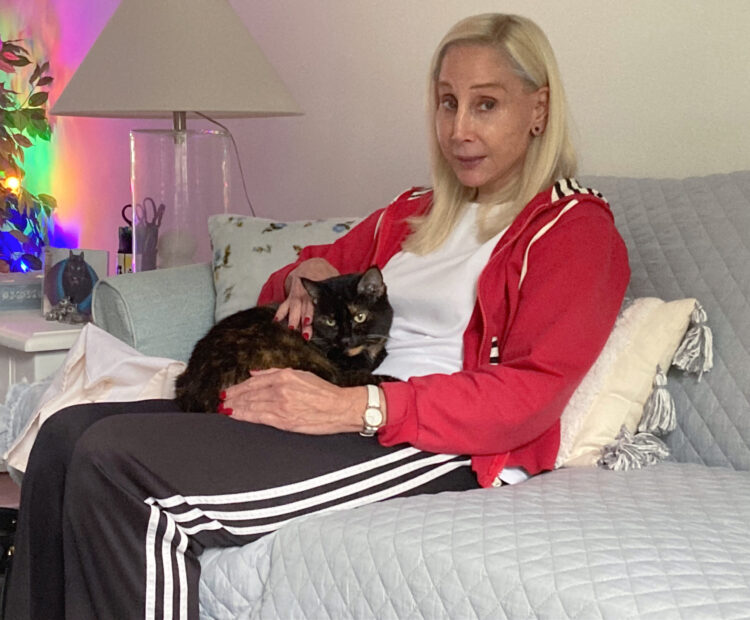
I attended Kathy’s support groups for several weeks following Feebee’s death, and gradually, the initial sharp pain receded. I learned how to move through my grief, and how to open my heart again. And just like he changed my life in so many other ways, he clearly had one more trick up his paw: Kathy and I became close friends. I’m fortunate that for the past 24 years, I’ve been able to call this compassionate woman my BFF.
Kathy offers phone sessions worldwide, and limited in person sessions in the Northern Virginia area. For more information about Kathy, and to schedule a session, please visit novapetlosssupport.com.

When I was 14, I lost my cat, Clyde. He was only eight. They didn’t have all-night vets back then, & he yowled in pain all night long.
I was a coward & got in bed with my parents, & I feel guilty as hell now that I did not stay with him, but I was afraid he might lash out in his pain & hurt me.
Doesn’t that sound dumb?
Anyway, the next day, my mom made me go to school. I was bullied, & the last thing I needed that day was to be in school!
I’m so sorry you had such an awful experience, Kitty. You did the best you could at the time. I would encourage you to contact Kathy, or another grief counselor, if you feel that you still need help processing this experience.
Just lost my Cat Daisy Mae recently on February 13, 2024, so I am still in the grieving process and wonder how long is to long? I thank you for the post but knowing that it was sudden, and we don’t even really know what happened makes things worse at least we have her pawprints in a cast at her death to remember her by thankfully.
I’m so sorry about your Daisy Mae, Crystal. I’ve always felt that sudden death is even hard to deal with than when it’s anticipated. There’s no such thing as “too long,” as Kathy said in this post, every individual grieves differently.
There is a guilty feeling when you grieve more for the lost pet than for your parents.
Probably it is they give you unconditional love. Never judge you and always happy to see you. It is hard to get that in a human.
I still so often think about Samantha who died after surgery in 1990 at the age of 4 1/2 years. I cried for days. There have been others, some were easier to let go and some were not. I have 2 4 year olds now and the oldest I thought was going to die, but she has improved over the past week. Being retired and having them around me most of the time makes the bond stronger and I really need them to make it into their teens. Only devoted pet owners understand the grief.
I think you’re right, having them around most of the time deepens the bond. Here’s to both of your 4-year-olds living well into their teens and beyond!
I have noted and kept her number for future reference. It seems that every loss of my pets have become so much more intense to deal with. I don’t know how I’ll be able to cope when I loose Tasha when that time comes.
I feel that way when I think about loosing Allegra, Theresa. Here’s hoping that neither of us will have to face those losses for a very long time.
I also had way more pain when my sweet soul kitty died than I did when either of my parents died. It’s because we live with our fur babies every day. They are our children. The only grief I will never get over is for my late husband. He was my soul mate. Bereavement counseling helped me to learn to live with it.
Bless Kathy and all the counselors who help us live again after loss.
I’m glad counseling helped you deal with your grief, Debi.
It’s great Kathy has this for those who need her. I could have used her advice after I lost Nani. I bonded with her more than any other cat I had.
Some losses hit so much harder than others, don’t they.