By Ingrid R Niesman MS, PhD
Part One: Protecting Your Cats
In May of last year, I wrote that the current newsworthy avian influenza strain of H5N1 was infecting and killing domestic cats. At the time, I noted that while surveillance and caution were prudent, we shouldn’t panic.
Like many scientists, I believed we needed to observe, test and evaluate data before creating a public stir. The CDC, WHO, and other regulatory agencies have long and successful track records for understanding flu outbreaks and deploying effective containment protocols. With good data, my hope was that a steady cross-country march would be slowed or stopped.
Predictably though, due to multiple human factors and the numerous agencies required for surveillance and testing, this virus is spreading rapidly with no signs of slowing down. Therefore, the time that we should be paying attention and doing something is urgently needed now.
The current strain of H5N1 is deadly for cats
Clade 2.3.4.4b, the current strain of the highly pathogenic influenza type A (HPAI) is deadly for our domestic cats. This is a fact. 20 out of 24 suspected infections of large feline species at the Wild Felid Advocacy Center in Shelton, WA died after symptoms progressed rapidly. Three of the four survivors recovered and the current fate of the fourth is unknown.
Up until 2023, less virulent strains, also termed clades, of HPAI H5N1 were circulating worldwide. Cats were infected and died but not at the levels seen beginning in early 2023 and into 2024. Upon autopsy, viral loads of the less virulent clades were restricted mainly to respiratory systems. This all changed with the newer clade 2.3.4.4b. Cats are now showing up with neurological symptoms that prove deadly, and less classical flu-like respiratory involvement.
Just how deadly is Clade 2.3.4.4b?
A highly cited pre-print manuscript (MedRxiv, 12/2024) calculates the fatality following infection in domestic cats as high as 89% for clade 2.3.4.4b. Any disease that is projected to kill about 90% of its victims warrants our attention quickly.
Graduate student Ian Bemis of the Department of Veterinary Medicine at the University of Maryland, lead author of the study, shared that “the data we used for the mortality calculation was based on reliable PCR/DNA diagnostics.” He warns that “the situation today is much more serious for cats than for humans.”
We have documented H5N1 positive cases of multiple cat deaths at dairies, poultry farms and in private homes. Cat to cat transmission is likely through saliva, feces and direct contact. The only good news is, at this time, no human to cat transmissions of HPAI H5N1 have been verified, although the Global Center for Health Security at University of Nebraska Medical Center reports a suspected case in Michigan occurring in July 2024. We need to keep it that way for our cats’ sake.
Known environmental sources of H5N1
Suspected infections of backyard poultry flocks, cattle and wild mammals appear to be caused by waterfowl flocks during their long annual migrations. The virus is now so widespread that even Antarctic wildlife has been affected. H5N1 is persistent and infectious in cool aquatic sources, in bird droppings, and even on shed feathers for days, even up to weeks, making environmental control nearly impossible.
A comprehensive list of mammals known to be susceptible to H5N1 is growing daily. Everything from red foxes (canids) to sea lions (marine life) have been found and documented. Of particular importance for our outdoor, community and feral cat populations is the prevalence of infected rodents, a main source of prey.
Concerns about viral replication and mutation
Influenza, as an RNA virus, is highly prone to mis-reads of nuclei acids during infection and replication within a host. These types of viruses lack the proof-reading systems that DNA replicating ones employ. In other words, they mutate easily and can recombine with other similar or related viruses to create a whole new monster.
Shubhada K. Clothe, PhD, BVSc & AH, a veterinary scientist at the University of Pittsburgh, is concerned about this possibility. “RNA viruses mutate at a high rate,” she says. “Unchecked, this virus may easily adapt to cats and find a permanent home.”
What you can do right now
Vigilance starts at home. There are many small steps that cat parents can do right now to help prevent another serious pandemic. The easiest and most important one is handwashing. Do it often and thoroughly. The virus can live on surfaces when deposited by aerosol droplets, in raw human foods, or in contaminated water, to cite just a few examples. Information on actual infectious viral particles required for initiation of symptomatic H5N1 is sketchy, so aiming for zero is a good number to protect our cats.
Bobbi Brink, the founder and Director of Lions, Tigers & Bears, a fully accredited sanctuary in Alpine, CA, recommends taking your shoes off before entering your home. “You can step in the smallest of bird poop and drag it all around your house,” she says. The sanctuary is currently using full PPE (personal protective equipment), including shoe covers, to protect their animals.
Some other simple steps recommended by Bobbi Brink include frequently changing and disinfecting uncovered outdoor water containers such as birdbaths. Lions, Tigers & Bears keepers are trying to keep their water sources under covered areas, reducing the possibility of accidental aerial bird droppings.

Clean up all areas of bird poop outside your house, especially around and under your wild bird feeders, areas near open windows and screens, and walkways into your home and decks. If you have a pool, carefully maintain pool disinfection protocols.
With 93 mountainous acres, Lions, Tigers & Bears has a big job of monitoring wild birds residing within the sanctuary. “We are very worried about the animals in our care,” explains Bobbi Brink, “but as San Diego isn’t on known waterfowl migratory routes, there is less chance for accidental spillover infections.” However, no staff, veterinarians or volunteers that have any contact with backyard poultry flocks are allowed access.
Be observant of your natural surroundings. Report any dead birds, rodents, raccoons or skunks to your local animal control agency as quickly as possible, preventing cats or other wildlife from feeding on carcasses. If you want to clean up or remove them yourself, use disposable gloves and a KN95 mask. At this point, any dead bird should be highly suspected as H5N1 infected.
Raw poultry diets pose a serious risk
Besides the practical and easy steps mentioned above, several more proposed interventions may be controversial at this time and will depend on your individual risk tolerance.
Raw poultry diets currently pose a serious risk to your cats. This includes chicken, turkey, duck and goose. Under most circumstances, I would find more definitive scientific data to present, but I feel the urgency to save cats and people now. As cat parents, the choice is yours to make. The risk is unacceptable to me and my two Siamese kids.
There is a literal cascade of daily reports documenting cat deaths from suspected food sources; most recently, California (11 confirmed) and Oregon (2 confirmed). Although there is some dispute about testing protocols and food sources, somehow these cats were infected with H5N1, and not from wild birds or human sources.
Andrea Tasi, VMD, a feline veterinarian and owner of Just Cats, Naturally and a long-time proponent of feline raw diets recently told me “I am just not comfortable feeding raw poultry at this time. And definitely don’t feed raw unpasteurized milk.” She is providing a similar message to her clients. Her advice, along with some raw food suppliers, is to heat raw food to 165oF slowly to maintain nutrient content. The preferred method is sous vide, cooking vacuum sealed food in a temperature-controlled water bath. Food can also be gently sauteed. This should be done slowly on low heat, and all liquid rendered from the cooking process should be served with the food. The food should be completely cooled before serving. Microwaving doesn’t cook food evenly and is not recommended. An additional caveat to remember about microwaving, heating using microwaves requires molecules of water to vibrate and generate energy. Freeze-drying, by definition, removes all water from the material. Don’t microwave commercially freeze-dried foods or treats.
An option worth exploring if you choose to continue to feed raw is sourcing your cat’s food and treats from manufacturers in New Zealand or Australia where no animal infections have been detected as of December, 2024.
Sadly, for zoos and sanctuaries, such as Lions, Tigers & Bears, large felids need a raw diet. Switching to cooked meals would be detrimental to their health and well-being. Bobbi Brink says they are carefully screening their meat supply and only serving human-grade meats.

Non-dietary interventions
If your cats go outside, the wisest course of action, if possible, is to keep them indoors for the time being.
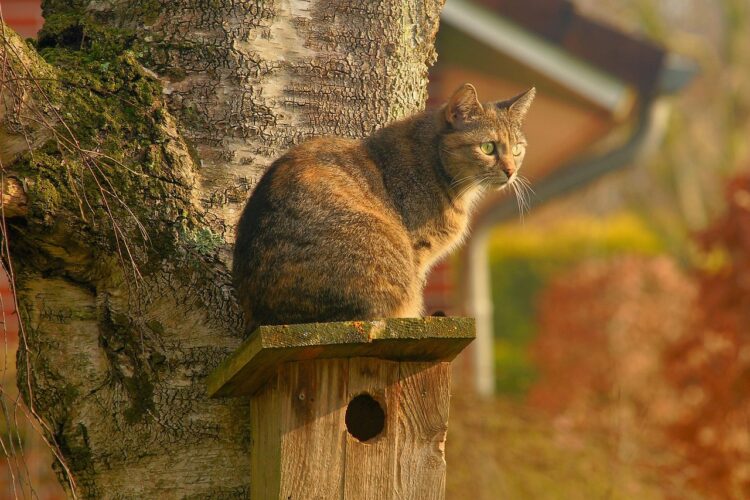
My two young kids, Fierce and Tasha, have been indoor only cats since they were adopted because the population explosion of local coyotes impacts our backyard. They had limited access to a second story deck where their huts are covered. Yet, birds frequently use the railing when the cats are inside, leaving behind their droppings. Hence, I am using my own advice by cleaning the areas carefully, spraying my shoes with disinfectant and leaving them outside, while restricting Fierce and Tasha’s access to the area.
A final recommendation involves cat parents. Get your usual flu vaccine, it’s not too late. Seasonal flu is surging throughout the US after the holidays, creating exactly the conditions required for cat and human co-infections with H5N1 and the circulating flu strain. The longer each virus is retained in an individual, the greater the risk for genetic recombination, adapting mutations and serious illness.
There currently is no approved feline H5N1 vaccine and cats are not routinely vaccinated for seasonal flu strains. Thus, they need the protection that you can provide.
Coming soon, Part Two: Why clade 2.3.4.4b is so devastating to the feline species
I will explain how and why this clade 2.3.4.4b is so devastating to cats, where we are in developing diagnostic capabilities, what symptoms to watch for and any guidelines for treatment, isolation and hopefully future vaccination recommendations from US and global veterinary societies.
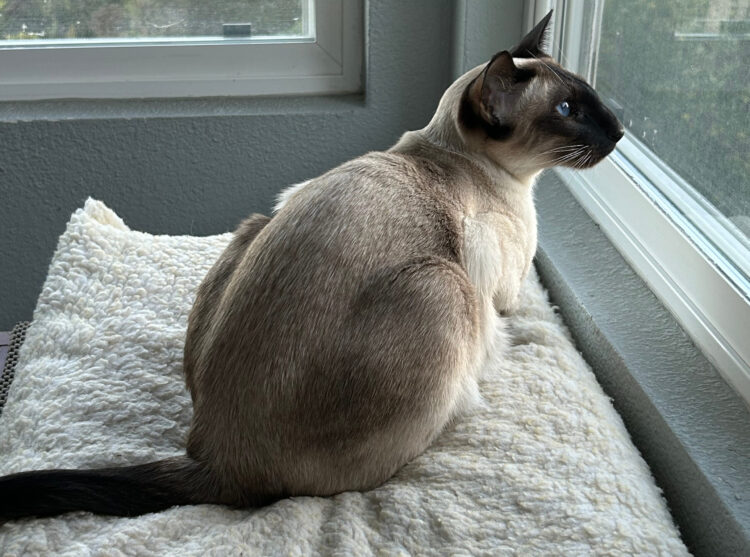
Photo of Tasha watching the birds courtesy of Ingrid Niesman
Ingrid R. Niesman MS PhD is the Director of the SDSU Electron Microscope Imaging Facility at San Diego State University. She graduated from Utah State University and received her MS from the University of Illinois-Urbana-Champaign. After 30 years of technical electron microscopy, cell biology, neuroscience and infectious disease research, Dr. Niesman completed her PhD in the UK at the University of Sunderland. Her work experience includes time at LSU Medical School, Washington University, UAMS in Little Rock, UCSD, TSRI and a postdoctoral year at CALIBR in La Jolla, CA. She has worked for at least two National Academy of Science members and is credited with over 50 publications. She can be reached at [email protected]

I’ve been feeding my cat Smalls and I think it is lightly cooked. Should I stop now?
I believe it is lightly cooked since it’s sent refrigerated right? Not being a pet food expert, I can’t say for sure what temp they suggest as lightly cooked but here is the verbiage from website. “No, none of our products are raw. Our fresh food is gently cooked to an internal temperature of 165°F (73.9°C) to ensure safety”. 165o is sufficient to kill H5N1. I’d carefully watch for any potential recalls however.
I know I am hesitant to feed my cats anything but highly sterilized foods, but I have lost two beloved cats in the past few years and can’t bear the thought of losing my young kids. Therefore, I am very risk adverse. The choice is yours but if what they state is accurate, and I have no reason to believe otherwise, their food should be safe by current standards..
What is a healthy food I can feed my cat that is 100% safe? The Smalls is costing $178.00 every 42 days. I don’t care about cost. I just want to make sure it is totally safe.
I’m not an expert but I have been reaching out to a local manufacturer to get more information about the state of cat food in the era of H5N1. Based on what Smalls states, their food should be safe. Before last summer, I had considered trying one of the gently cooked meals for my kids, but between some logistical issues involving our vacation house (remote) and developing bird flu, I opted to stay with the really safest choices. If I were you and were happy with the results of your food, I’d reach out to Smalls and request to be on a list for immediate potential recalls for peace of mind. Otherwise, turn to canned foods as they are safe from H5N1.
Is simple hand washing enough after you add new bird seed to bird feeders? We have one cat. We have a ‘no shoe’ policy, but if someone comes over & takes their shoes off, but they do not have a ‘no shoe’ policy at their home & walk around in socks–but other people wear shoes–couldn’t the virus be on their socks & still get on our carpet? Am I being overly paranoid? Thanks.
Hand washing should be enough as long as you do it thoroughly – the same 20 seconds they told us to do during Covid. As for your second question, yes, I suppose it’s possible in your scenario that they could carry virus particles on their socks. It’s hard not to be paranoid with a threat like this!
I concur with the other Ingrid. Careful handwashing is fine after filling your feeder. I do a squirt of hand sanitizer as well but that is a remnant of my bench science days. Unless you or your company are walking through heavy areas of bird poop – like a sidewalk near water where geese may flock, you are probably ok just taking shoes off.
Here is an example of my “paranoia” – so you know you are not alone. My husbands’ walking companion went to spend afternoon with a friend who is known as the chicken guy on Sun. I made my husband leave shoes outside (of course) but made him strip off all outer layer to dump immediately in the washer after walking with him this morning.
My main advice is always on the side of caution. But you should also be practical. Do what really fits your needs. We don’t know much about transmission of this virus right now. It may be that severe infections need oral routes and lots of virus. Environmental exposure may be limited. I’m just advocating more precautions as protection. I plan to follow my gut and do as much as I can to protect my cats.
All that said, probably your suggested scenario isn’t a huge issue. The amount of virus would be tiny and your cat would have to step directly onto it. Unlikely for sure but not zero. Maybe the easiest thing would be to just vacuum after they leave?
Ingrid Niesman
I have read with horror the highly appreciated article written by Dr. Niesman. We have 35 rescue-cats (10 of which kittens), with 10 older adult cats indoor/outdoor; the other cats and kittens presently indoor only. We also have (so far, free running) 7 pet chickens. And we are presently living on a property boarding agricultural land with every farm animal and also wildlife (including wild flocks of turkeys, quails and pheasants) you can think of.–We are octogenarians with health problems and very little available hired help. This results in us being terribly overworked.–Nevertheless, we would lock up our chickens and make all of our cats indoor-only if the danger to them were substantial. Local cattle owners, egg producers, and vet clinics, are likely to play down the danger because it would hurt business. We have tried to get info from government agencies (USDA and USU) to find out how bad the situation is here in northeast Utah (Uintah County), but they claimed not to know. Keeping all cats indoors puts my husband and me at risk for suffering a heart attack being constantly overworked. But we both love our cats. With no living descendants, our cats are our children. What shall we do?–I have tried to contact Dr. Niesman using the e-mail address in your article, but this e-mail address seems no longer working.
Hello Lilo
My major question for you is do your indoor/outdoor cats routinely hunt? Or are they well fed? If they aren’t actively hunting, especially wild birds, then try just keeping an eye on them the best you can given your situation. You can try and actively reduce any hunting by providing extra food if you have to. Keep water bowl very clean and under a covering – even a box with a hole cut in will be adequate.
Watch for any symptoms and immediate isolate the sick cat and CALL the VET with your suspicions. Don’t be intimidated if they aren’t as aware. If you can, have a separate room for the indoor/outdoor kids, like a garage just as a safety buffer for now.
As far as the chicken’s go – I’d probably keep mine close to a pen at least or only let out supervised for a few hours in a tightly controlled area. Check the area for other bird droppings – if you see any, keep the chicks inside. Only provide water inside the coop.
Do watch and call USU (my alumamater) about local positive flocks and cattle. Reports are coming out more swiftly now as this gets more serious.
Lastly, keep a spray can of Lysol handy to spray your shoes, etc. Follow common sense anti-infection guidelines. When in doubt, wash twice, change your clothes and wash in hot water.
You are probably ok but you do have a number of risk factors – cattle, wildfowl and chickens in close proximity to your cats. I’d say the worst thing you could do right now is feed raw food.
If you’d like to talk to me directly here are my emails. Reach out anytime.
[email protected]
[email protected]
[email protected]
Good reason to keep your fur babies indoor! I worry about all the feral cat colonies out there.
Thank you Ingrid for that excellent article. I have forwarded it on to many. I had wondered about continuing with Darwins. I suppose it is fine to use up what I have (do you think this is so?) but Her Majesty will have to switch to canned food when that is gone.
You and Allegra are in my prayers and Reiki every day. Hope she is feeling better.
Love,
Patty & Cricket
Thank you for sharing this. I am hoping it will reach a wide cat-centric audience quickly. Remember you can always heat the Darwin’s to protect your cat for now. Or buy the pricier NZ or Aust brands of raw diets but the caveat there is that we don’t know for how long considering the rapid spread worldwide.
The other Ingrid – Ingrid Niesman PhD
Yes, I think it is fine to use up what you have. As to whether to continue to feed raw really just depends on your risk tolerance.
Thank you so much for your prayers, Patty!
This is an excellent article and I learned a lot. I have several backyard bird feeders and I am very concerned about coming into contact with the virus when I fill the feeders. I’m going to discontinue feeding the birds until it is safe for me to do so. I don’t want to accidently infect my cat-his continued good health and life are my priorities.
I have a lot of bird feeders, too, Lynnette. My backyard birds bring me so much joy, I just don’t have the heart to stop feeding them. I practice diligent hygiene after handling feeders and never wear outside shoes inside the house.
There always seems something to worry about with our babies. Thanks for all of this info.
Thank you for the excellent information. I have been reading about and have warned some friends who have pets. I guess because it is not been widely spoken about in the news people don’t seem to take it seriously. I read where some cats foods have been recalled because of some cats dying.