By Dr. Kris Chandroo, DVM, MSc, HBSc
I had just taken over a case from a colleague who had moved on to another vet clinic. There were numbers everywhere, neat little boxes of bloodwork and urine results, and a blood pressure reading series that needed to be conveyed by phone.
“Dr. Kris, can’t you just tell me what my cat has?” the owner asked. “Your cat has CKD (Chronic Kidney Disease,) and we can help him!,” I told him. ” Let’s talk about it.”
My colleague had mentioned that dehydration might have nudged the values, that perhaps it was not CKD at all, so further testing was required. But as our conversation continued, it became clear that the man on the phone did not want to hear about more tests, the “CKD” word, or that anything might be wrong. He justifiably wanted a firm answer, right now.
We went through the diagnostics, where the numbers danced just a little too high or too low in that typical CKD pattern.
“But Dr. Kris, how do you know for sure?”
That is when I said what I often say in moments like these. “This is where we put the paperwork down and talk about your cat in real life. Tell me about him. What is he doing at home that has you concerned the most?”
And then the story came. The quiet weight loss. The skipped meals. The vomiting. The soft signs that whisper between “he is just getting older” and “something deeper is happening.”
I explained that yes, those signs fit with chronic kidney disease.
He paused on the phone. “You are still not telling me what the problem is. Explain it in stages – like the other vet was going to.”
I said every cat is different, and while stages are useful, it’s much better to just figure out their individual needs, regardless of stage, and that way, we reveal their real health potential.
I then paused, and said “he’s CKD Stage II, non-hypertensive, proteinuric.”
He thanked me. His voice was steady, but it was like his hope clung to the word staging as if it were a life raft. To be anything other than Stage I was, for him, the sound of hope quietly slipping out of the room.
I never heard from him again.
When you hear the term “CKD”
The moment someone hears “CKD,” the world tilts a little. It is not just a medical moment, it is an emotional one too. Especially when someone still uses that grim, old phrase “kidney failure.” That word alone feels like a trapdoor opening under your feet, and the first quiet whisper of how long do we have.
What most people do not realize is that when CKD is discovered, it has usually been quietly present for some time, tucked away behind ordinary days and subtle signs. So if you have just heard those three letters, if your chest feels tight and the world has gone strangely quiet, please know this: you are not alone, and you are not a bad cat parent.
There are three things I want you to know in this moment:
1. Forgive yourself
Cats are mesopredators. Aka, the middle children of the food chain. Their best defense is pretending everything is fine. They are evolutionary masters of the poker face.
That means you can love them, feed them, notice everything, and still miss the early signs of CKD. You did not fail your cat. You simply played opposite to one of nature’s greatest actors.
Forgiveness is not a poetic luxury. It is a necessity. It lets you breathe again. It clears the fog so you can start helping. The moment you can say, “I did not cause this, but I can help now,” the healing begins, for both of you.

2. Holding space for uncertainty and fear
After the shock comes uncertainty. Questions arrive in waves. Is this reversible? How quickly will it progress? Will they be okay?
CKD is not a sprint with a finish line. It is more like a tide that comes and goes, calm some days and restless on others. Some cats stay stable for years. Others change quickly. Every journey is its own story. Which is why I rarely talk in “stages” unless asked.
Instead of racing ahead to predict everything, try to hold space for what you do not yet know.
Sit beside your cat during a blood pressure check. Watch their chest rise and fall. Allow yourself to cry the first time you give SQ fluids if that’s part of your journey. Know it will take three attempts to find a way for them to accept that new supplement or food. Forgive the part of you that feels powerless. You are not powerless.
To hold space is to stay in the unknown without turning away. To say, “I do not have all the answers, but I am here.”
Your cat will feel that stillness. That steady presence is medicine, just as real as anything in a syringe.
3. Spring into action, because they depend on you
After the fear and uncertainty fade, just a little bit, there comes a quiet determination. Your cat still looks to you for food, safety, and comfort, and now for leadership too.
This is where love becomes motion.
Small steps matter most. You cannot fix everything, but you can improve a great deal. Keep track of body weight, because every ounce is a clue.
Maintain hydration, because fluids are life.
Watch phosphorus and potassium, because these quiet minerals shape appetite and energy. Protect intestinal health, because the gut and kidneys are lifelong dance partners.
These are the BITE strategy fundamentals, the same ones I teach in Nine Lives, One Mission. They are not simply treatment steps. They are a way to regain agency in a situation that at first feels like it has none.
You cannot undo CKD. But you can slow it. You can bring back appetite, comfort, and bright eyes. Every improvement, no matter how small, is a victory counted in moments, not months.
The quiet heroism of staying
When that man thanked me on the phone, and then vanished, I understood. Sometimes the truth arrives before the heart is ready to open the door.
But many of you reading this will do the opposite. You will stay. You will research and measure, feed and hydrate, monitor and love. You will cry in the kitchen and then find courage in the next breath. You will learn more about feline biology than you ever thought possible!
That is love in its most grounded form, the kind that does not flinch.
So if today was the day you heard “CKD,” breathe. Forgive yourself. Hold space for fear. Then, when you are ready, pick up the syringe, the food bowl, or the notebook where you write weight and appetite.
Because your cat needs you, and you are already enough.

Dr. Kris Chandroo (DVM, MSc, HBSc) has spent years in the trenches of real-life feline medicine, traveling from living rooms to laundry rooms to help cats live longer, happier lives. He’s turned his clinical know-how into vet-approved, lifesaving playbooks, videos, courses and blogs. He is the founder of 100x Mobile Vet, a mobile veterinary service with several locations in Ontario, Canada.He is the author of Nine Lives, One Mission: Vet-Approved Home Treatments for Cats with Chronic Kidney Disease (CKD).a comprehensive guide to this common disease in cats. Every page of this book is infused with Dr. Kris’ compassion and determination to give cat parents the tools and the confidence to make the right decisions, always in partnership with their veterinarian.
Image Adobe stock photo
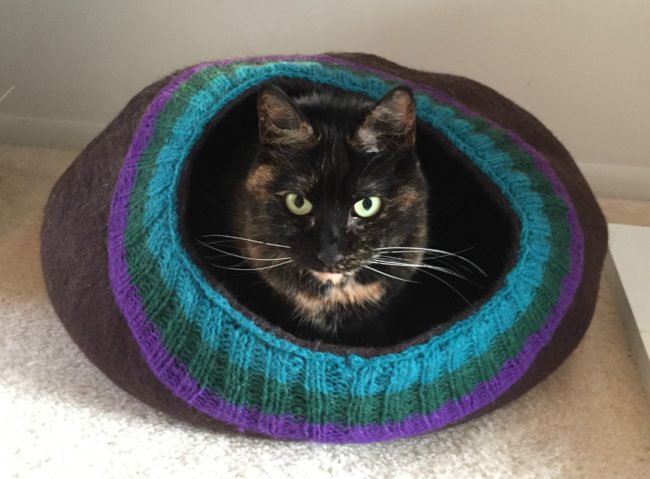
Dr Kris is a great writer, and I enjoyed reading his book. Packed with great information. I have Tasha on Azodyl 3 caps a day put into her food, amlodipine for her b/p and Vit B12, and laxatives to keep her plumbing humming. When she gets blocked up, she will not eat. She is on an appetite stimulator along with cerein and cisapride. Also lacatlose 3 cc twice a day. She goes to the vet every 3 months for lab work and gets a monthly arthritis injection. It is a full time job just keeping up with her meds. There’s nothing I wouldn’t do to keep her comfortable.
It is a full time job, isn’t it? And yet, every day with these precious cats is a gift.
My first cat died from CKD (and a heart condition). My two oldest cats have IBD and early CKD. I have been and will continue to do everything I can to help them! I have Dr. Kris Chandroo’s book and I will be reading it this fall. Thank you for this post.
Solid advice! Our journey ended in July after five years. It was not easy. We chose to make the work doable with persistence, love and grace. We were always on alert for the signs from our girl that it was ok to forge ahead or accept it was time to let go.
Thank you for this advice. We hope we never need it, but it’s good to have in case we do.