By Ingrid R Niesman MS PhD
As we are learning more about H5N1 avian influenza A (HPAI), we know it has proven deadly to cats. 10 cats in Oregon became infected after eating raw food. Their disease progression has taught us much about how this virus affects cats.
The H5N1 clade 2.3.4.4b loves feline cells, with serious consequences
Unlike humans, cats’ respiratory track can be easily infected with the virus. Worse news is that cats’ brains and lungs are even more susceptible to viral invasion than the upper respiratory system.
A report in the Journal of Veterinary Diagnostic Investigation in late 2024 (Mainenti, et al., 2024) describes the most consistent pathological finding upon necropsy of H5N1 positive cats from New Mexico and Texas as neurological lesions in brain cortex and brainstem.
Based on that and similar studies, our current clade 2.3.4.4b has shifted the paradigm of infections seen in earlier versions of the virus. Bronchioles and lungs were the sites of disease prior to the emergence of clade 2.3.4.4b. Increasing neurological involvement and gastrointestinal symptoms and less respiratory involvement are confounding diagnosis and early interventions in our current infections.

H5N1 outbreak in Oregon affects 9 cats in the same household
The following real-life scenario can happen anywhere, with very traumatic outcomes.
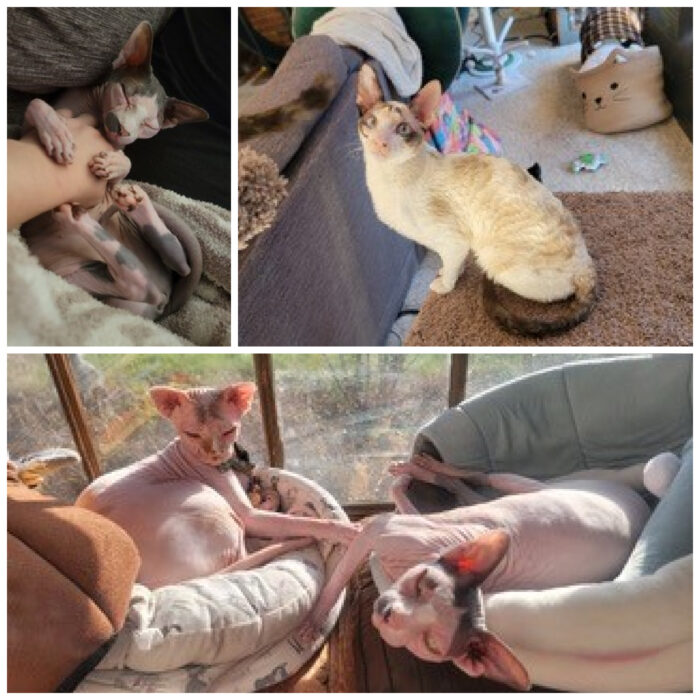
Kiki Knopp, a long time breeder of Cornish Rex cats and an artist, (KiKiDoodle, Purrmaids) is living through one of the first highly publicized and heartbreaking H5N1 infections in her cat colony. “I have some minor veterinary sense and keep a close watch on the health of all my cats,” she told me. “I am trained to do simple at home procedures.” She entrusts her cats’ heath to a feline veterinarian. By all accounts, she is a thoughtful, careful and responsible cat breeder and cat parent. Her personal cats are Sphynx cats. Her story is tragic, yet bittersweet, and a cautionary lesson for everyone involved in caring for cats.
She is to be praised for her bravery to speak out in her time of grieving and recovery. Her experience with this disease, treatment and aftermath provides many clues to previously undocumented symptomology, transmission and disease outcome. Given the swiftness of her two losses and positive test results from 9 of her 11 cats, we now have several important avenues of investigation.
All but one of Kiki’s cats ate Wild Coast Raw food. The Washington State Department of Agriculture (WSDA) and the Oregon Department of Agriculture (ODA) issued a public health warning after testing batches of the food and samples from the affected cats. Her two negative cats are an intact breeder male, isolated separately due to intercat behaviorial issues, who is fed a canned and kibble diet, and an older feral who didn’t eat much of the raw food.
It is easy to detect fevers in Sphynx and Cornish Rex breeds due to their limited fur. The first of Kiki’s cats, a 13-year-old female named Gandalf, began her cycle of fevers, hypothermia and loss of appetite on Thursday morning 2/6/25, with a temperature of 103ºF. KiKi noted the rest of her colony seemed a little off, so she thought maybe a bug was going through the cats. By Sunday evening, after syringe feeding and hydration, Gandalf appeared to be failing. She was visibly wobbly and unbalanced. Kiki carried her to the litter box. On Monday, Kiki scheduled an in-home euthanasia for the following morning. Gandalf was given pain meds overnight but declined steadily.
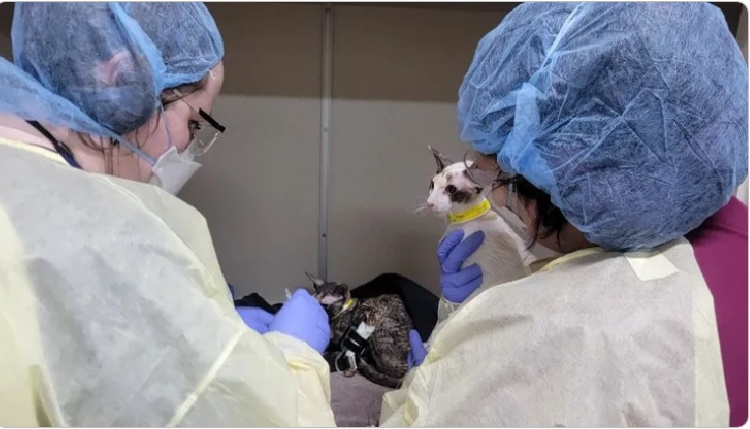
In the interim, her 5-year-old Cornish Rex Sekhmet and her daughter Hattie began displaying abnormally high respiratory rates in combination with fevers. To ward off dehydration, both girls were given fluids and syringed food. On Wednesday 2/12/25, Kiki’s veterinarian saw both cats. During the differential diagnosis, X-rays were being taken. At that time, a representative from the ODA called and asked if Kiki was willing to turn over her cats’ bodies upon probable death. Stunned, she then listened to her veterinarian describe that it was going to be nearly impossible to survive the pneumonia both cats faced.
That was the first time in a week that the realization her cats were infected with H5N1 sunk in. Besides Sekhmet and Hattie, at least three other kitties, Bebop, Piggy and JiJi, were showing signs of infection.
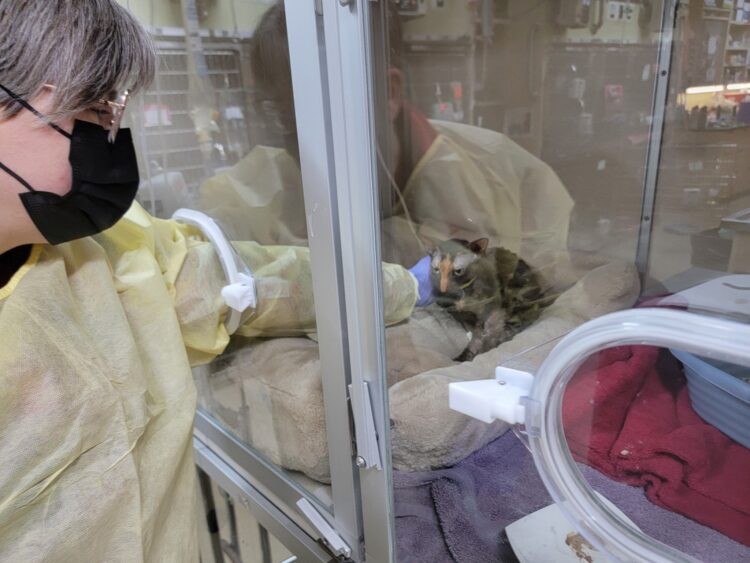
With Sekhmet and Hattie hospitalized in an oxygen chamber, the race was on to save their lives. The pneumonia was so extensive that the outcome was grim. Tamiflu, in liquid form as a last resort treatment, was only available 30 miles away, in a heavy snowstorm. Kiki and her partner braved bad roads and lost time with the sick cats to acquire the only three doses. Both Sekhmet and Hattie were treated, leaving only one dose for her to use on a cat back home. “It was like a version of Sophie’s Choice,” said Kiki. Ultimately, she gave it to one of her males, JiJi, who seemed to be developing rapid breathing. Among all the cats, he recovered the fastest.
Sekhmet looked after her daughter Hattie during the whole ordeal, as Hattie slowly slipped away. In the middle of the snowstorm, Kiki made the difficult decision to let her go. She couldn’t even make it through the storm to say good-bye on Valentine’s Day. Afterwards, Sekhmet appeared to give up, only rallying after Kiki was able to don full PPE and spend quality time with her, getting her to eat and drink on her own.

Finally, her fever broke, her appetite improved and after six days in an ICU oxygen chamber, Sekhmet got to come home. She is the first cat known to have survived white lung pneumonia from H5N1.
Because of her heightened awareness, Kiki was able to immediately get her youngest kitten Bebop hydrated and confined to an ICU oxygen chamber, which led to the second survival story.
All totalled, 10 of her 11 cats have tested positive for H5N1, with Gandalf’s test done post-mortem. The loss of two cats is devasting, but the lesson from Kiki’s ordeal is that through quick responses and excellent care we may be able to save infected cats. These cats should not have died in vain.
Throughout her nightmare, which is ongoing considering that long-term recovery from an illness this severe is unknown, Kiki has been transparent, open and inspiring. She recommends that cat parents get an ear temperature monitor for accurate multiple checks. “Don’t dismiss H5N1,” she says. “Start considering this early in any suspected cat fevers. Act fast if you think your cat has had any exposure risks. Monitor breathing rates. Don’t let it progress to pneumonia.”
The non-canonical symptoms such as lack of upper respiratory coughing, nasal discharges or weepy eyes hindered early care for Gandalf. Recognition of her developing neurological involvement clued ODA into the issue early, so all the cats were able to be tested multiple times, aiding in data collection for timelines, infectivity and transmissibility.
Of all the lessons exposed by Kiki’s case, the fact that she and all her family and friends, veterinary team and other responders involved in the colony’s care are consistently testing negative for H5N1 by PCR is important. While anecdotal for now, this is strong evidence that cat to human transmissions may be difficult. However, human to cat transmission can be deadly. “I was syringe feeding, hugging, taking temperatures and holding my cats during blood draws and other procedures,” explains Kiki.
Future for treatments may be bleak
Whether Tamiflu was able to help late in the disease course will need careful evaluation by the veterinary team. However, a research group from Canada has just posted a report of a mutation in the N1 sequence that confers resistance to Tamiflu (Signore, 2025). Availability for use by veterinarians may be highly restrictive if resistance develops quickly, limiting treatment options for our cats. The best outcomes will probably occur with prompt recognition, which requires frequent testing. Insist your cat is tested if you suspect bird flu due to exposure risks.
Information, awareness and rapid response may be the keys for feline H5N1 survival
It is pretty clear that raw cat food was responsible for the infections in Kiki’s cats. While feeding raw is still an individual choice, dependent on each cat parent’s risk tolerance, given what we know about poultry infections, layoffs of USDA food inspectors and sampling for testing quality, the far safer choice is to forgo raw feeding for now. The risks are lower for carefully chosen manufacturers, but the consequence for our cats is real if something sneaks by, as Kiki’s story revealed.
I urge you to take this information seriously, especially since the daily and weekly epidemiology reports scientists and veterinarians relied upon from federal agencies have all but disappeared.
It’s easy to feel lost and alone as we are navigating our new reality, with fewer resources, less surveillance and no approved H5N1 feline vaccine. Our cats are a strength and source of joy during difficult times. Each loss cuts deeply into our entire community. Please support Kiki Knopp during her grieving period. She wasn’t even able to receive ashes, or paw prints from her deceased cats.
No one knows what the prospects for her infected cats are. Let’s hope she continues her advocacy and updates everyone frequently on their progress.
Ingrid R. Niesman MS PhD is the Director of the SDSU Electron Microscope Imaging Facility at San Diego State University. She graduated from Utah State University and received her MS from the University of Illinois-Urbana-Champaign. After 30 years of technical electron microscopy, cell biology, neuroscience and infectious disease research, Dr. Niesman completed her PhD in the UK at the University of Sunderland. Her work experience includes time at LSU Medical School, Washington University, UAMS in Little Rock, UCSD, TSRI and a postdoctoral year at CALIBR in La Jolla, CA. She has worked for at least two National Academy of Science members and is credited with over 50 publications. She can be reached at [email protected]



I saw where the FDA did a recall on this food and I posted it to fb. It is so scary. I am so sorry for her loss. I know it must be devastating.
Thank you for sharing this, Ingrid. You are, as always, a –and often the–trusted source for information about caring for our beloved feline family members.
This is all so heartbreaking. I saw that we have had four outbreaks in our county and where we live we are surrounded by waterways and there are geese everywhere. It is gutting to see the first signs of Spring and not take Fig for hikes or be able to look forward to camping trips this Spring. I’m doing my best to keep all my cats entertained indoors but this is going to be brutal.
It is awful, especially for cats like Fig who love the outdoors so much.
Heartbreaking. During this time I would NOT feed any raw food to my cat. If you have cats that are indoor/outdoor, I beg you to keep them inside if you love them. Cats dying of this disease is heartbreaking.
This is heartbreaking. I couldn’t imagine losing one of my cats to this, much less that many.