This is a sponsored post*
The answer to the question “how much should you feed my cat?” isn’t as straightforward as it would seem. And even though every can and bag of cat food provides feeding instructions, these guidelines are pretty much useless, because multiple factors impact how much a cat should eat.
Factors that impact feeding amounts
Age
There is no single definition for what age range each lifestage actually comprises. The American Association of Feline Practitioners’ Feline Lifestages Guidelines classify lifestages as follows:
- Kitten: birth up to 1 year
- Young adult: 1 to 6 years
- Mature adult: 7 to 10 years
- Senior: 10+ years
- Geriatric: 15 plus years
Even though pet food companies market so called lifestage diets and would like you to believe that each of these lifestages requires a different diet, when it comes to how much to feed your cat, only two lifestages really matter: kitten and adult.
In the wild, kittens will nurse from their mother for the first three to four months of their lives. After that, the mother will gradually introduce her kittens to solid food by teaching them to hunt. The prey they learn to catch is what cats in the wild will eat for the rest of their lives.
Activity level and metabolic rate
Just as each person has a unique individual metabolism, cats’ metabolic rates vary as well. An active cat who gets a lot of exercise will burn more calories than one who sleeps most of the day.
Body condition
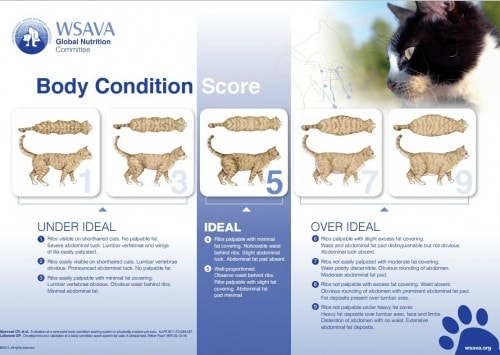
The body condition chart below can help you determine whether your adult cat is at a normal weight.
The biggest mistake: feeding too much
The most common mistake cat parents make is too feed too much – and frequently, that’s because they follow the manufacturer’s feeding instructions on the label. Feline obesity is an epidemic, with more than 61% of America’s cats being considered overweight or obese, and it comes with all the same health problems in cats as it does in humans: diabetes, arthritis and other joint problems, heart and respiratory problems, a compromised immune system, and gastro-intestinal problems.
How much food does a cat need?
Calorie content can vary widely from one brand of cat food to another. Pet food manufacturers are required to list a food’s calorie content on the label. Read the information carefully. Calories may be listed per cup, or per can or pouch.
To keep an average adult cat at a healthy, normal weight, feeding recommendations range from 24 to 35 calories per pound of body weight.
Since nutritional needs can vary considerably depending on the factors mentioned above, it’s a good idea to weigh your cat regularly and adjust the amount you feed accordingly.
How often should cats eat?
Leaving food out for your cat all the time is the single biggest factor in causing obesity in cats. Free choice feeding goes against the cat’s natural habit of being a hunter who may only eat two or three small meals a day. For most people, feeding two meals a day is the most practical solution, but if you work from home, you may want to consider dividing the total amount of food for the day into three or four meals.
Special considerations for kitten
Kittens need more food per pound of body weight than adult cats, and they will need more frequent meals. Use label recommendations as a starting point, and feed your kitten as much canned or raw food as she will eat until she is about four to six months old, in three or four meals a day. Since kittens’ nutritional requirements vary even more than adult cats’, remember to monitor her weight and body condition and adjust accordingly. Once your kitten reaches six months of age, you can start feeding her as an adult cat.
Special considerations for seniors
In older cats, muscle condition is a better indicator than weight. You will be able to feel bones in senior cats even if they are overweight if they’re starting to lose muscle mass.
Contrary to what pet food manufacturers would like you to believe, senior cats do not need diets that are lower in protein or calories. In fact, the opposite is true: senior cats become less efficient at metabolizing fat and protein as they age and may actually require more protein and more calories than younger cats to compensate for diminished absorption of nutrients.
Always provide plenty of fresh water
You hopefully already know that you should dry food is a poor nutritional choice for cats. Not only does dry food not provide enough moisture for cats to stay properly hydrated and prevent urinary tract problems, it is too high in carbohydrates for an obligate carnivore like the cat. Even cats who eat raw or canned food should always have plenty of fresh water available.
About Darwin’s Natural Pet Food
Darwin’s is doing everything right, both in terms of what’s in the food and what’s not:
- 100% meat – no animal-by-products or fillers
- Ethically sourced human grade ingredients from farms they trust
- Formulated under the guidance of veterinary nutritionists
- Free range, pasture raised, cage-free meats
- No GMO
- No steroids
- No hormones
- Made fresh: you will receive your meals 4-6 weeks from production
- Ready to serve
Darwin’s statement on H5N1
Darwin’s is very selective in choosing which suppliers we work with. We have been in contact with our poultry suppliers who all have testing protocols in place for a range of viruses, including H5N1, and will not ship products from flocks in which even one bird tested positive. In addition, as part of Darwin’s normal production process, all our meals are treated with an organic Peracetic Acid solution, which is effective against multiple pathogens, including H5N1.
If you are concerned about feeding raw, cooking poultry to a temperature of 165° Fahrenheit will destroy H5N1. Sous viding is the gentlest option that retains the most nutrients. Since sous viding is not always accessible for all pet parents, we also recommend very gently sauteing Darwin’s. This should be low and slow, and all liquid rendered from the cooking process should be served with the food. The food should be completely cooled before serving.
Special offer: Get 75% off your first 10 pounds
Darwin’s has an introductory offer that can’t be beat so you can try this for your own cats: get 75% off your first 10 pounds of raw food. You can customize the proteins depending on your cat’s taste preferences.
Use code PURRSOFWISDOM to take advantage of this special offer.
For more information and to order, please visit DarwinsPet.com.
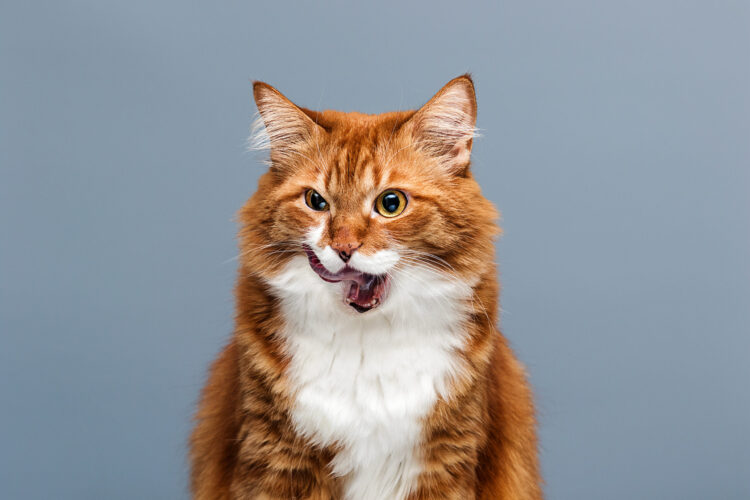
Photo Adobe stock image
*This post is sponsored by Darwin’s Natural Pet Products. Purrs of Wisdom is an affiliate partner of Darwin’s Natural Pet Products. This means that if you decide to purchase through any of our links, we get a small commission. We only spread the word about products and services we’ve either used or would use ourselves.

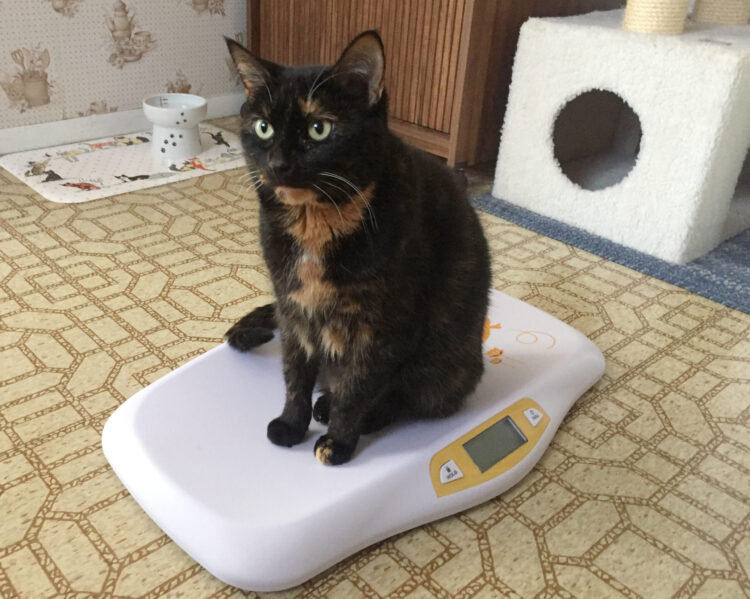

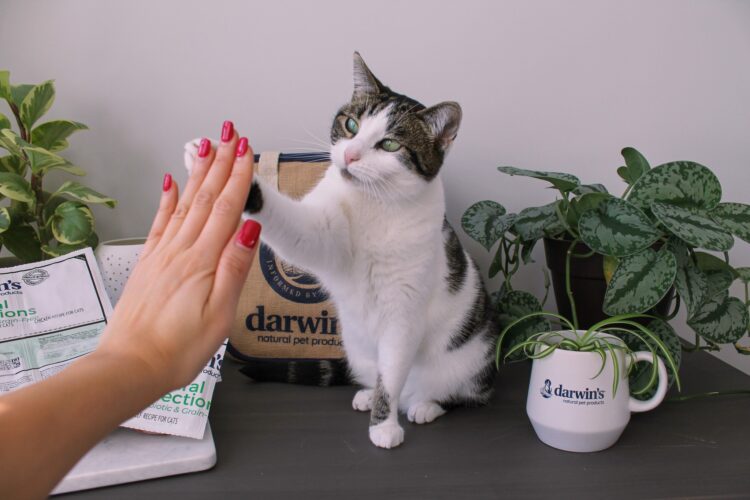
I learned the hard way how easy it is for a cat to gain weight by leaving a food bowl out all the time. We struggled to get Pono to lose weight. He chunked up fast with the food bowl out and full all the time.